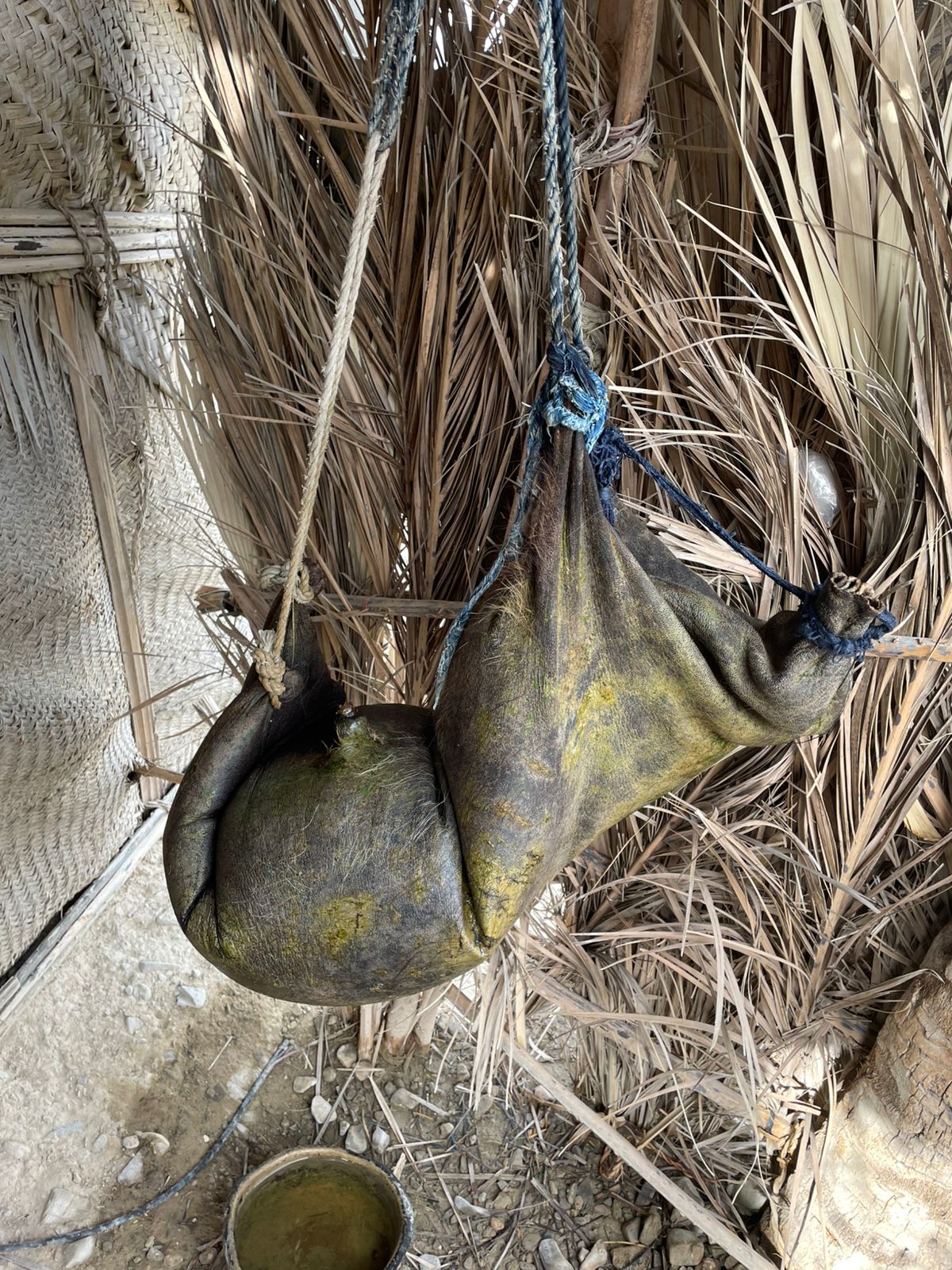
Tabahig is a traditional dish of the Baloch people, made with pomegranate powder and salt. It is typically made after Eid-ul-Adha, and can be eaten throughout the winter. In the old days, Baloch people did not have refrigerators or electricity, so they had to find ways to preserve their food. Tabahig is a clever way to do this, as the pomegranate powder and salt help to dehydrate the meat and extend its shelf life. To make Tabahig, simply marinate the meat in a mixture of pomegranate powder and salt, then hang it in a shady and windy place to dry. Once the meat is completely dry, it can be stored for months
Sustainability, Resilience and Food Security: Methods—such as sun drying, leather sack curing, salting, smoking, clay pot storage, fermentation, and ash or sand pits—require no electricity and use minimal resources, making them environmentally friendly and cost-effective. Ensure food availability during periods of scarcity or unreliable energy access.
Cultural Knowledge Sharing: These techniques help preserve intergenerational knowledge, while the article also offers suggestions on how they can be adapted to be utilized in modern societies.
Why Traditional Food Preservation Matters
Long before the invention of refrigeration and modern technologies, the Balochi people developed ingenious methods to store food without electricity. In the arid and rugged landscapes of Balochistan, a region spanning parts of Pakistan, Iran, and Afghanistan, the Baluch people have long relied on traditional knowledge to survive and thrive in a challenging environment. Could these methods be relevant today?
Today, as we face global concerns around energy access, climate change, and food insecurity, these ancient practices offer more than historical insight, they provide practical solutions. For those seeking low-cost, eco-friendly solutions that honor tradition while supporting food security and self-reliance, homesteaders, off-grid families, and educators are looking to traditional food preservation methods.
This sacred knowledge is typically passed down by generation and reflects a deep commitment to community resilience and resourcefulness. While it is the Nosach Project’s mission to promote digital literacy and share technology in rural Balochistan, where resources and infrastructure are lacking, we also aim to support cultural preservation. This article is going to share with you some core Baluch traditional food preservation methods. We extend this valuable knowledge to our friends and supporters, as we introduce you to simpler and more conscientious ways of preserving food.
Many parts of the world are faced with challenges such as rural Balochistan, where access to electricity is limited or unreliable. In such a context, traditional food preservation techniques are not just cultural artifacts—they are vital tools for food security, especially in times of scarcity, drought, or economic hardship. There is much to be revered and learned from these methods, as they offer sustainable, low-cost alternatives to modern refrigeration, aligning with global efforts to reduce energy consumption and food waste. Here are five notable methods that you may want to experiment with:
We will start with one of the most basic methods. Sun drying is perhaps the most widespread and accessible method of food preservation in Balochistan. The region’s intense sunlight and dry climate make it ideal for dehydrating fruits, vegetables, and meats is easy and requires no special equipment.
Among the Baluch people, one of the most distinctive preservation techniques involves using a leather sack, locally called charma or pashk, to cure meat. This method is deeply rooted in nomadic traditions and is ideal for long journeys or harsh winters. This method will probably not be the new homesteader’s go-to solution for preserving meat. In fact, I’d recommend we might leave this one to the experts:
Modern Method: Try out dry-aging bags for meat that are readily available, known as a delicacy in some foodie-circles.
Salt is a powerful preservative, drawing moisture out of food and inhibiting bacterial growth. Salted or cured meat will keep up to a year but it is critical to follow precise instructions to ensure the meat is properly preserved, especially when using curing salts, as improper methods can lead to risks. Cold smoking meat will keep it longer. (If you've been to Italy or Spain, those legs of meat hanging in their shops can be over five years old!) In Baluchistan, salting and smoking meat are staples.
Unglazed clay pots are used to store water, milk, and even grains. The porous nature of the clay allows for natural cooling through evaporation. The pot's porous clay allows a small amount of water to seep through and evaporate from its outer surface. To evaporate, the water draws the necessary latent heat from the remaining water inside the pot, which lowers the water's temperature. Keep in mind, milk is usually collected from the goats in the morning and stored in the matka for use until the following morning when the supply is replenished.
Modern Method: Many co-ops and organic food markets encourage customers to bring their own containers for refilling from bulk bins. Not only are using traditional pots for food storage a way to save packaging waste, they are a beautiful addition to your kitchen and pantry.
Fermentation is used to preserve dairy and enhance its nutritional value. This is not a means of long-term storage, but rather used to extend the life of raw milks.
Modern Method: If you are going to go this route, you better invest in a goat, because store bought milk undergoes a flash-heating process called pasteurization that destroys the majority of its active bacteria needed to undergo fermentation.
For root vegetables like onions, garlic, and potatoes, Baluch households often use ash or sand pits to keep them dry and cool. This traditional method of food preservation protects the vegetables from rotting by limiting moisture, air, and microbial growth, effectively extending their shelf life for months. Before being placed in the pit, vegetables are harvested on a dry day, their skins are allowed to "cure" in the sun for a few hours, and any loose soil is brushed off. temperature just above freezing (32–40°F).
.JPEG)
As climate change and energy insecurity become global concerns, the Baluch people's methods offer valuable insights:
Cultural Preservation: Reviving and respecting these practices helps maintain cultural identity and intergenerational knowledge.
.png)